What to Do When Your Sewer Backs Up:
A 5-Step Guide for Twin Cities Homeowners
Stop. Breathe. Here’s what to do in the next fifteen minutes.
If you’re reading this on the basement stairs, looking at water where it shouldn’t be, start here: do not run any more water (even from somewhere else in your house), and do not try to clean it up yet. Now that you know that, we’ll get to a quick five-step guide to help you get through this.
How to Know You Have a Main Sewer Line Backup, Not Just a Clogged Drain
Quick! Figuring this out changes what you do next, so it’s worth thirty seconds.
Signs of a main line clog:
- Several drains slow or backing up at once, rather than just one.
- Toilets gurgling when a nearby fixture drains.
- Sewage surfacing somewhere unexpected: a floor drain, a basement tub, the laundry standpipe.
- A sewer smell in the basement or yard.
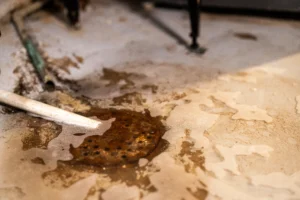
One slow sink is likely a local clog. An overflowing toilet because too much toilet paper was used one time is also an isolated situation. On the other hand, several fixtures acting up together, or sewage at the lowest drain in the house, points to the main line running out to the street. That needs a faster, different response.
Step 1: Stop Running Water Immediately
Every gallon entering your plumbing while the main is blocked has to go somewhere, and right now that somewhere is your floor. Stop any dishwasher or washing machine mid-cycle. Do not flush toilets. No showers, no sinks, no laundry until the line is clear.
Note: If the problem is obvious and isolated, such as an overflowing toilet or a faucet with a broken handle that won’t shut off, locate the water shut-off for that individual item and shut it off quickly until the issue can be resolved. It’s also a good idea to familiarize yourself with the water shut-offs for all sinks and toilets in a non-emergency scenario so you’re ready.
Step 2: Protect What You Can
- Move boxes and small furniture off the floor, if you can do it without walking through standing sewage.
- Keep children and pets out of the area. The CDC advises keeping them away until cleanup is finished.
- Take photos before moving or cleaning anything. Your insurer will want them.
- Do not clean sewage yourself. Where sewage is involved, the CDC calls for rubber boots, rubber gloves, and goggles at minimum.
- Leave the wet vac in the closet. That comes after the line is cleared.
One note the checklists often skip: if outlets, cords, or equipment are in or near the water, do not wade in to reach a breaker. The CDC advises shutting off power at the main breaker and calling an electrician rather than entering standing water to reach the panel.
Step 3: Do Not Reach for the Chemical Drain Cleaner
We understand the impulse. It will not help.
Products poured down a fixture are built for a clog in that fixture’s own drain, a few feet away. A main line blockage typically sits much further downstream, often out under the yard, so the product settles into standing water well short of the problem and stays there. Boiling water and the vinegar-and-baking-soda approach fall short for the same reason.
If you have already poured something down a drain, please tell us when we arrive.
Step 4: Locate Your Main Sewer Cleanout
The cleanout is the access point we use to reach the main line: usually a capped white or black pipe with a plug on top. Look on the basement floor near a foundation wall, in a utility room, on the garage floor, or outside near the foundation, sometimes buried under mulch or landscaping.
Do not unscrew the cap during an active backup. The line may be under pressure and can release without warning.
We can find and access it ourselves when we arrive, so this only saves time. If you are reading this and your basement is dry, go find yours now (along with the water shut-off valves for all sinks and toilets). It’s worth five minutes today, on a day that is not the worst day.
Step 5: Call Bonfe Underground (651) 332-6633
- 24/7/365 emergency service, because sewer lines do not check the clock.
- Regular rates from 7 am to 10 pm, seven days a week, with no evening or weekend upcharge inside those hours.
- We bring a camera. Clearing the blockage is the first step, not the whole job.
- Same-day or next-day scheduling for follow-up work.
Why Sewer Backups Happen in Twin Cities Homes
- Tree roots working into older clay and cast iron pipe joints, common in our mature neighborhoods.
- Grease and cooking oil building up on the kitchen line.
- Wipes labeled “flushable”. Municipal wastewater agencies report these do not break down the way toilet paper does.
- Aging pipes. Mid-century cast iron and clay are reaching the end of their service, as is Orangeburg, a bituminized fiber pipe that was common in Minnesota homes from the 1940s through the 1970s.
- City-side problems, including surcharges in heavy rain and backups starting in the municipal main.
What Happens After the Sewer Backup is Cleared
Clearing the line solves today. Finding out why it happened keeps you from repeating this in eight months, which is why we recommend a camera inspection once the immediate problem is handled. Depending on what we find, options range from a targeted spot repair to a trenchless liner that rehabilitates the pipe without digging up your yard.

Then call your insurance agent. The Minnesota Department of Commerce says a typical homeowner’s policy will not cover sewer backup damage, and neither will flood insurance. Coverage requires a separate product or endorsement. Worth asking before any future issues come up.
Why Choose Bonfe Underground for Sewer Services?
- Bonfe Underground is the sewer and drain division of Bonfe, family-owned since 1993.
- Twin Cities specialists who know the pipe materials, layouts, and quirks of older homes across Minneapolis, St. Paul, and the metro.
- Upfront pricing, with no surprises once the job starts.
- 4.8 stars from over 11,500 Google reviews.
- Regular rates 7 am to 10 pm, seven days a week, plus 24/7/365 emergency service.